

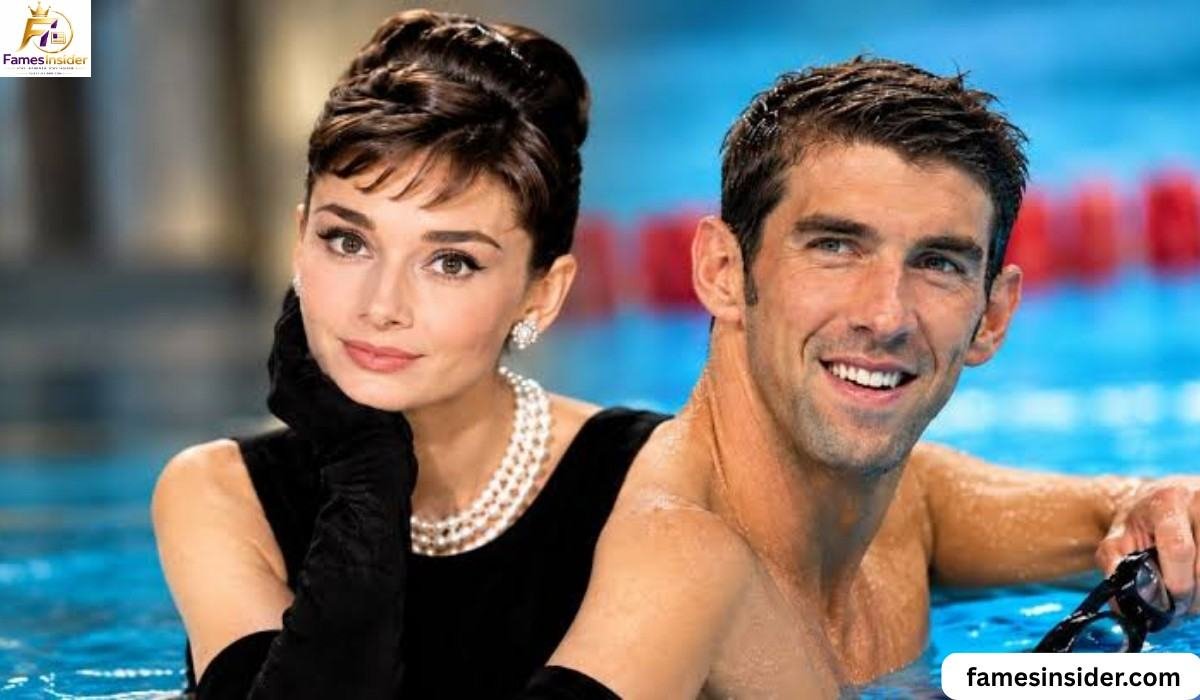
Type two names into Google that have nothing obvious in common, and you’ll sometimes stumble onto a pairing search engines just can’t stop connecting. Audrey Hepburn and Michael Phelps is exactly that kind of match. One built her name on classic cinema screens in the 1950s. The other built his in swimming pools nearly half a century later. Yet both climbed to the very top of professions that demand relentless discipline, and both eventually turned global fame into something far more meaningful than fame alone. This guide walks through their early life, defining career moments, family stories, wealth, and the legacies each one left behind long after the cameras stopped rolling.
What makes this comparison genuinely worth reading isn’t the contrast alone, though that’s real enough. It’s what happens once you look past the obvious differences. Hepburn’s film career eventually gave way to humanitarian work with UNICEF, while Phelps’s Olympic dominance opened the door to advocacy work most athletes never touch. Their achievements live in completely different record books, sure, but their instinct to give back once the spotlight found them tells a surprisingly similar story. That’s the thread this article follows from start to finish.
Audrey Hepburn and Michael Phelps at a Glance
Before we go deep, let’s zoom out first. Audrey Hepburn was a British actress who defined elegance during Hollywood’s golden era. She charmed audiences through quiet grace rather than loud spectacle. Michael Fred Phelps II is an American swimmer whose name now means Olympic greatness itself. Nobody in swimming history comes close to his medal count. Their wealth tells different stories too. Hepburn earned hers through selective film roles and lasting brand partnerships. Phelps built his through decades of sponsorship deals signed both during and after competition.
Take a look at the table below. It sums up both icons in seconds, and it sets the stage for everything that follows in this guide.
| Detail | Audrey Hepburn | Michael Phelps |
| Full Name | Audrey Kathleen Hepburn | Michael Fred Phelps II |
| Born | May 4, 1929 | June 30, 1985 |
| Birthplace | Brussels, Belgium | Baltimore, Maryland |
| Profession | Actress, humanitarian | Olympic swimmer, entrepreneur |
| Best Known For | Roman Holiday, Breakfast at Tiffany’s | 28 Olympic medals |
| Olympic Gold Medals | Not applicable | 23 gold medals |
| Humanitarian Role | UNICEF Goodwill Ambassador | Founder, Michael Phelps Foundation |
| Estimated Net Worth | $55–100 million at death (estimates vary) | $80–100 million (widely cited) |
Audrey Hepburn Quick Facts
Audrey Hepburn’s biography blends film, fashion, and humanitarian service into one remarkable life. She survived a hard wartime childhood in the Netherlands. Then she trained in ballet training before acting found her almost by accident. Roman Holiday earned her the Academy Award for Best Actress on her very first major role. That single film made her a permanent fixture of classic cinema, and it launched a career that fashion historians still study today.
Also Recommended For You : Stephanie Maloney Katz: Dan Katz’s Wife, Career & Private Life
Michael Phelps Quick Facts
Michael Phelps’s biography centers on discipline and grit built over decades of early mornings. As a competitive swimmer, he represented Team USA at five Olympic Games between 2000 and 2016. He walked away with 28 Olympic medals, including 23 Olympic gold medals, a record nobody else in Olympic history has come close to matching. After retiring, he shifted his focus entirely. Today he champions mental health advocacy and water safety through his foundation, proving his influence didn’t end when his competitive career did.
Who Were Audrey Hepburn and Michael Phelps?
Name two people with nothing in common, and this pairing might come up first. Audrey Hepburn was a Hollywood icon known for grace and understated style rather than loud glamour. Her film career shaped how actresses were styled and photographed for decades afterward. Michael Phelps, meanwhile, is an Olympic swimming champion whose records still stand today, untouched by anyone who’s come after him. His name is now shorthand for swimming excellence itself, the same way Hepburn’s name became shorthand for cinematic elegance.
But look closer, and their stories start to rhyme in one important way. Both reached the top of brutally competitive fields through years of quiet, unglamorous work. Both later turned that fame toward something bigger than themselves once the spotlight softened. Hepburn gave her energy to UNICEF and vulnerable children around the world. Phelps built programs around mental wellness and young swimmers learning to stay safe in the water. Fame, it turns out, can point the same direction even when the paths leading to it look nothing alike.
Audrey Hepburn’s Early Life and Background
Audrey Hepburn’s early life began on May 4, 1929, in Brussels, Belgium. It wasn’t an easy start by any measure. World War II swept across Europe during her childhood years, and she experienced its worst effects firsthand. She faced food shortages, constant fear, and repeated displacement. Those experiences shaped her far more deeply than any acting class ever could have.
She turned to ballet training during the war years, partly as an escape and partly for the discipline it offered. Dance gave her structure when everything else around her felt chaotic and uncertain. After the war ended, she kept dancing and slowly drifted toward performing more broadly. Then luck struck in a way nobody could have predicted. French writer Colette spotted her and picked her, almost on instinct, for the lead role in Broadway’s Gigi. Soon after that stroke of fortune, she landed the lead in Roman Holiday. That single role changed the entire trajectory of her life.
How Audrey Hepburn Became a Hollywood Icon
Everything changed with one film. Roman Holiday, starring opposite Gregory Peck, gave Hepburn her breakout moment on the world stage. Her performance felt fresh and disarming in a way audiences hadn’t quite seen before. It earned her the Academy Award for Best Actress on her very first major role, a feat that’s still remarkably rare even by today’s standards. Her screen presence mixed elegance with genuine warmth and quiet humor, and audiences noticed immediately.
From there, her Audrey Hepburn films kept the momentum going without a single misstep. Sabrina, Funny Face, Breakfast at Tiffany’s, and My Fair Lady each added new layers to her image and expanded her range as an actress. She became one of the defining faces of classic Hollywood across an entire decade. But her reach went far beyond acting alone. Audrey Hepburn style started shaping fashion trends everywhere she appeared, turning her into something more than just a talented actress of her era.
Audrey Hepburn’s Family and Personal Life
Behind the glamour, Hepburn guarded her privacy fiercely, even at the height of her fame. Her personal life centered on family above everything else, including her own career ambitions. She made deliberate choices throughout her life to protect that space from public intrusion. She married twice, and each relationship shaped a distinct chapter of her story. Eventually, she found a long-term partnership she later described as the happiest years of her entire life.
Her approach to fame ran opposite to what most people expect from a star of her stature. Instead of chasing more roles or more headlines, she scaled back once motherhood became her clear priority. She chose quiet family life over constant visibility, a decision few actresses at her level ever made. That single choice reveals a lot about who she really was beneath the polished public image everyone still remembers today.
Marriages and Relationships
Hepburn’s romantic history includes two marriages and one lasting partnership that outshone them both. She married actor Mel Ferrer in 1954, and that marriage lasted until 1968. Her second marriage, to Italian psychiatrist Andrea Dotti, ran from 1969 to 1982. Starting in 1980, she partnered with Dutch actor Robert Wolders until her death in 1993. She later called those thirteen years the most fulfilling of her entire life.
Children and Family
Audrey Hepburn had two sons across her two marriages, and her Audrey Hepburn family life grew increasingly central as she aged. Sean Hepburn Ferrer was born in 1960, during her marriage to Ferrer. Luca Dotti arrived in 1970, during her second marriage to Dotti. Raising her boys became her top priority almost immediately. That priority directly shaped her decision to step back from acting during the late 1960s.
Her Life Away From Hollywood
By the late 1960s, Hepburn had mostly walked away from regular film work to focus on her sons. She wanted to raise them without Hollywood’s constant noise and scrutiny following every move. She settled at La Paisible, her farmhouse in Tolochenaz, Switzerland, far from studio lots. Life there moved slower and quieter than anything she’d known before. Humanitarian work eventually took root in that calm, and it would go on to define her later years just as strongly as acting once did.
Audrey Hepburn’s Fashion and Cultural Influence
Few actresses shaped fashion the way Hepburn did, and that influence still holds up decades later. Her partnership with designer Hubert de Givenchy remains one of cinema’s most iconic creative pairings, a collaboration that outlasted most of her actual films. The clean lines and simple silhouettes behind Audrey Hepburn style weren’t accidental choices. They reflected a real philosophy: less truly can be more, even on a movie screen built for spectacle. That idea still guides designers today, decades after she first wore it well. Breakfast at Tiffany’s fashion, especially that black dress, turned into one of film’s most recognized images of all time.
Her cultural footprint stretches far beyond costume design, though. You’ll spot her influence in photography, advertising, and modern red-carpet choices made by stars who weren’t even born when she was alive. Many celebrities still echo her preference for simplicity over spectacle, whether they realize it or not. Fashion trends usually fade within a season or two, sometimes faster. Hers never did. That durability is exactly why fashion historians keep studying her choices, long after everyone else from her era has been forgotten.
Audrey Hepburn’s Humanitarian Work With UNICEF
Somewhere between acting and her final years, Hepburn found what became her most meaningful work. Her humanitarian missions for UNICEF were never staged photo opportunities designed for headlines. She traveled to some of the world’s hardest places, often at real personal risk to her health. She spoke publicly, sometimes through tears, about what she witnessed there firsthand. This wasn’t a side project tacked onto a fading career. It became the defining chapter of her later life, arguably more important to her than acting ever was.
There’s a personal thread running through all of it, too, one that explains her genuine commitment. As a child during the war, Hepburn had received food and medical aid tied to early UNICEF relief work in the Netherlands. That experience never left her, even decades later. It’s part of why her advocacy for children’s welfare felt genuine rather than performative, and audiences at the time noticed that difference immediately.
Becoming a UNICEF Goodwill Ambassador
Hepburn officially became a UNICEF Goodwill Ambassador in 1988, a role she took seriously from day one. She didn’t waste time putting the position to use. Shortly after her appointment, she traveled to Ethiopia during a severe humanitarian crisis and spoke candidly about the suffering she witnessed firsthand. Interview after interview followed, each one using her global fame purely as a tool for raising awareness rather than for personal attention.
Humanitarian Missions Around the World
Her UNICEF travels covered a remarkable number of countries across several continents. She visited Ethiopia, Turkey, Bangladesh, Vietnam, and Sudan, among many others over five years. In Bangladesh alone, she spent a full week touring schools and community health projects back in 1989. Records even show her personally helping vaccinate a child against polio during one visit. That level of hands-on involvement was rare for a celebrity ambassador at the time, and it still stands out today.
Her Advocacy for Children
Hepburn didn’t just lend her name to causes and quietly walk away afterward. She pushed actively for better health, education, and protection for vulnerable children everywhere she traveled. In 1992, the same year doctors diagnosed her cancer, she still traveled internationally on UNICEF business without slowing down. She kept speaking out publicly right up until her declining health finally made that impossible for her to continue.
How Did Audrey Hepburn Die?
By late 1992, Hepburn had started losing weight and complaining of stomach pain during a UNICEF trip to Somalia, though she initially dismissed it as exhaustion from constant travel. Doctors in Los Angeles eventually diagnosed appendiceal cancer, a disease so uncommon that even specialists rarely encounter more than a handful of cases in their careers. It typically spreads silently for years before producing any noticeable symptoms, which is exactly what made her case so hard to catch early.
Surgeons attempted to remove the tumor, but scans later confirmed the cancer had already reached her colon. Hepburn chose to spend her remaining time at La Paisible rather than undergoing aggressive treatment in a hospital setting, a decision her son Sean later described as entirely her own. She passed away on January 20, 1993, with Robert Wolders and her two sons by her side. Audrey Hepburn was 63. Her funeral in Tolochenaz drew a small, private gathering rather than the media circus many expected, exactly the kind of quiet exit she’d have wanted.
Michael Phelps’s Early Life and Swimming Career
Long before medals entered the picture, Michael Phelps was known around his Baltimore neighborhood simply as the kid who couldn’t sit still. Born on June 30, 1985, he grew up in Rodgers Forge, a quiet suburb near Towson, Maryland, during a childhood complicated by his parents’ divorce when he was just nine. School proved difficult from the start. One teacher famously told his mother he would never focus on anything long enough to succeed at it. Swimming, oddly enough, became the answer nobody expected.
Childhood in Baltimore
Phelps entered the pool for the first time at age seven, partly to burn off restless energy and partly because his two older sisters, Whitney and Hilary, already swam competitively. Whitney, in fact, ranked first nationally in the 200-meter butterfly at just 15, before a back injury cut her own Olympic hopes short. Watching that intensity up close left an impression on her younger brother. By age 10, Michael had already climbed into the national rankings for his age group, a signal that this wasn’t just a sibling copying an older sister’s hobby.
ADHD and His Early Swimming Years
Around sixth grade, at age nine, doctors formally diagnosed Phelps with ADHD after years of teachers describing him as impossible to keep still. He started taking Ritalin on school days, and his mother later said it genuinely helped calm the hyperactivity that had frustrated his classroom performance for years. But the routine wore on him. Walking to the school nurse’s office every lunch period to take his medication in front of classmates left him feeling singled out and embarrassed. At 13, he asked his doctor if he could stop taking it altogether, convinced he could manage his focus through swimming instead. His mother, skeptical at first, eventually agreed, and Phelps weaned off the medication with his physician’s guidance rather than quitting cold turkey.
Bob Bowman and Elite Training
By age 11, Phelps had narrowed his focus entirely to swimming, training under coach Bob Bowman at the North Baltimore Aquatic Club. Bowman noticed something in him almost immediately, telling colleagues as early as 2000 that he expected this particular kid at Olympic trials within the year, and possibly contending for a medal by 2004. That prediction wasn’t far off. At just 15, Phelps qualified for the Sydney 2000 Olympics, becoming the youngest American male swimmer to make an Olympic team in 68 years. He finished fifth in the 200-meter butterfly that year, a respectable start that gave almost no hint of the record-breaking career about to follow.
Michael Phelps’s Olympic Career and Achievements
Statistics alone barely capture what Phelps did to the sport of swimming. Across sixteen years and five Olympic Games, he didn’t just win. He rewrote how fast humans were thought capable of moving through water, forcing rivals, coaches, and even swimsuit manufacturers to rethink their entire approach. By the time he finally left the sport for good, his name had become a kind of shorthand for Olympic dominance itself.
What makes the run even more remarkable is how close some of it came to going differently. A single hundredth of a second separated him from losing one of his most famous gold medals. A teammate’s furious final lap saved another. Greatness, it turns out, sometimes hinges on the smallest margins imaginable.
Five Olympic Games
Phelps debuted at the Sydney 2000 Olympics as a 15-year-old finishing fifth in the 200-meter butterfly, an ordinary start by his later standards. Four years on, Athens 2004 told a different story entirely: six golds and two bronzes, instantly establishing him as swimming’s next dominant force. Beijing 2008 followed with a performance still considered the greatest single Olympic showing by any athlete in any sport. London 2012 brought four more golds before his first retirement, and Rio 2016 closed the chapter with five golds and a silver, capping a career that spanned nearly two decades of competition.
28 Olympic Medals and 23 Gold Medals
When the totals finally settled, Phelps had claimed 28 Olympic medals: 23 gold, 3 silver, and 2 bronze. No athlete in any Olympic sport, summer or winter, has ever come close to that number. To put it in perspective, an entire small nation would need to compete for decades to match what one swimmer achieved in five Olympiads. His medals came from a mix of individual events and relays, proving he wasn’t just fast but consistently faster than everyone else across multiple strokes and distances.
The 2008 Beijing Olympics
Beijing stands alone as the defining week of his career. Phelps won eight gold medals at a single Games, breaking the previous record of seven held since 1972. One race in particular still gets replayed constantly: his 100-meter butterfly final, where he out-touched Serbia’s Milorad Cavic by just one-hundredth of a second, a margin so thin that slow-motion replay was needed to confirm the result. Two days earlier, teammate Jason Lezak had rescued the 4×100 freestyle relay with a blistering anchor leg, catching France in the final meters to keep Phelps’s perfect run alive. Without either moment, the eight-gold record likely never happens.
Olympic Records and Swimming Milestones
Phelps’s record collection extends well beyond his Olympic medal count. Across his career, he set 29 individual world records in long-course competition, plus another 8 as part of relay teams, according to Team USA figures. He also collected 34 World Championship medals along the way, a number that would define most swimmers’ entire careers on its own. Much of Beijing’s success also coincided with the LZR Racer swimsuit, a technology so effective that swimming’s governing body eventually banned similar suits, a rule change some fans still jokingly call the “Michael Phelps Rule.”
Retirement and Return to Competition
Phelps walked away from the sport after London 2012, convinced he’d accomplished everything he set out to do. Retirement didn’t suit him, though. Personal struggles followed, including a second DUI arrest in 2014 that pushed him into treatment and, by his own account, a genuine turning point in how he approached both his mental health and his career. He returned to serious training later that year and qualified for Rio 2016, where he added five more golds and a silver, serving as the U.S. flag bearer at the opening ceremony before retiring for good this time, closing out arguably the greatest individual career in Olympic history.
Read Must : How Old Is Malachi Barton? Age, Birthday & Biography in 2026
Michael Phelps’s Life Beyond Competitive Swimming
Retirement from competition didn’t quiet Phelps down. If anything, it gave him room to talk about things he’d spent years hiding behind a stoic game face. The same intensity that carried him through sixteen years of training got redirected toward causes that had almost nothing to do with winning races. Water safety, mental health, and helping kids find confidence became the new scoreboard, and by most accounts, he’s approached it with the same discipline that once got him out of bed for 4 a.m. practices.
That shift didn’t happen overnight, and it wasn’t entirely voluntary either. A difficult period following his last Olympics forced him to confront struggles he’d carried privately for years. What came out of that difficulty, though, reshaped how he now spends his time, and arguably how the public understands athletes long after their competitive careers end.
Michael Phelps Foundation
Phelps actually launched his foundation back in 2008, right after Beijing, using part of a $1 million bonus from Speedo to get it started rather than pocketing the money himself. Its flagship initiative, the IM Program, pairs basic swim lessons with goal-setting exercises and emotional wellness lessons for kids, a combination Phelps has said reflects lessons he wishes someone had taught him earlier. The program now partners with organizations including Boys & Girls Clubs of America and Special Olympics, reaching communities that often have limited access to formal swim instruction in the first place.
Mental Health Advocacy
Phelps went public about his own mental health struggles in 2018, describing periods of depression so severe that he’d considered ending his life after previous Olympic cycles, including following his second DUI arrest in 2014. That admission landed differently coming from someone widely viewed as invincible in the water. He later appeared in the 2020 HBO documentary “The Weight of Gold,” which examined the psychological toll Olympic competition takes on athletes once the cameras and sponsorships disappear. He’s since partnered with mental health platforms and spoken at congressional hearings, pushing for better support systems within Olympic sports specifically.
Water Safety and Youth Programs
Drowning remains one of the leading causes of accidental death among young children in the United States, a statistic Phelps cites often when explaining why his foundation prioritizes water safety above almost everything else. The IM Program doesn’t just teach kids to swim; it builds structured routines around confidence and emotional regulation, borrowing directly from what helped Phelps manage his own ADHD as a child. Partnerships with groups like Boys & Girls Clubs have extended that reach into neighborhoods where formal swim lessons were previously out of financial reach, turning a personal coping strategy into a program benefiting thousands of kids who’ll likely never compete in an Olympics themselves.
Michael Phelps’s Family and Personal Life
For someone who spent two decades chasing perfection in the pool, Phelps now describes a much simpler daily win: getting his whole family around one dinner table by five o’clock sharp. That routine, small as it sounds, has become central to how he talks about life after competitive swimming. Fatherhood reshaped his priorities almost overnight, and by his own account, it did more for his mental health than anything else he tried during his toughest years.
Wife and Children
Phelps first met Nicole Johnson, a former Miss California USA, back in 2007, though the two didn’t get serious until years later. They married on June 13, 2016, just weeks before the Rio Olympics, keeping the ceremony private. Their oldest son, Boomer Robert Phelps, actually arrived first, on May 5, 2016, and at just three months old he was already courtside in Rio, wearing tiny red-white-and-blue headphones while his dad added five more golds to his collection. Beckett Richard followed on February 12, 2018, Maverick Nicholas on September 9, 2019, and Nico Michael rounded out the family on January 16, 2024, giving the couple four sons in total.
Family Life Outside Swimming
Phelps has been candid about why routine matters so much to him now. Growing up with parents who separated when he was nine, he rarely got consistent family dinners, something he’s made a point of fixing with his own kids every single evening at 5 p.m. He’s said publicly that these small rituals helped pull him out of some of his darkest periods following retirement, giving his days a structure that training once provided. Boomer, now the eldest, has taken to cooking and card games with his father, small moments Phelps has called some of the most rewarding of his life, far removed from anything a scoreboard could measure.
Balancing Fame and Privacy
Despite four young boys growing up in a household with an Olympic legend for a father, Phelps and Johnson have kept most of their sons’ daily lives out of the public eye. Occasional Instagram posts mark milestones like births or first swim lessons, but school life, friendships, and everyday routines stay largely private. Johnson, who now serves as an ambassador for the Michael Phelps Foundation, has spoken about wanting her sons to grow up feeling normal rather than famous by association, a balance that isn’t always easy when their father remains one of the most recognized athletes on the planet.
Michael Phelps’s Net Worth and Income Sources
For an athlete whose face appeared on cereal boxes and billboards worldwide, Phelps’s actual swimming paycheck was surprisingly modest. Most of what built his estimated $80 to $100 million fortune came from outside the pool entirely, through deals signed once his name became a marketable brand rather than just a scoreboard entry. That gap between athletic achievement and athletic pay is common in Olympic sports, and Phelps’s career shows exactly how the math works.
Here’s a quick breakdown of where his income actually came from, rather than the medals themselves.
| Income Source | Details |
| Olympic Prize Money | No direct prize money; only USOC medal bonuses and occasional sponsor bonuses |
| Speedo Bonus (2008) | $1 million bonus for matching Mark Spitz’s seven-gold record, used to seed his foundation |
| Endorsements | Speedo, Under Armour, Omega, Intel; estimated $7 million a year at peak (Forbes) |
| Book Royalties | Autobiography “No Limits,” released after the Beijing Olympics |
| Business Ventures | Stakes in sleep technology and recovery science companies |
| Public Speaking | Corporate and mental health conference appearances |
| Foundation | Registered nonprofit; funds stay separate from personal earnings |
Swimming Career and Prize Money
Olympic swimming, unlike tennis or golf, offers no prize money at all for winning gold medals themselves. What Phelps did earn came through the U.S. Olympic Committee’s medal bonus program, which pays swimmers a set amount for each medal color, along with occasional sponsor bonuses tied to specific performances. The most notable came after Beijing in 2008, when Speedo awarded him a $1 million bonus for matching Mark Spitz’s seven-gold record from 1972. Rather than keeping the money, Phelps used it to seed the Michael Phelps Foundation, a decision that shaped much of his post-swimming identity.
Endorsements and Sponsorships
Sponsorship deals did the real financial heavy lifting throughout his career. Speedo, Under Armour, Omega, and Intel each signed him during his competitive peak, with Forbes once estimating his annual endorsement income near $7 million at its height. His autobiography, “No Limits,” released after Beijing, added book royalties to the mix, while paid appearances and brand ambassador roles kept income flowing well after he stopped racing competitively. Few Olympic athletes in any sport have matched the sheer breadth of his sponsorship portfolio, which stretched across swimwear, watches, tech companies, and financial services brands.
Business and Foundation Work
Beyond traditional endorsements, Phelps has invested in ventures tied loosely to health and wellness, including stakes in companies focused on sleep technology and recovery science, areas he’s said matter to him personally given his own struggles with mental health. Public speaking engagements now bring in steady income too, with Phelps addressing corporate audiences and mental health conferences alike. His foundation, notably, sits apart from all of this financially. It operates as a registered nonprofit, meaning donations and program funding stay separate from Phelps’s personal earnings, a distinction he’s been careful to maintain publicly.
Audrey Hepburn and Michael Phelps: Career Comparison
Put a film reel next to a swimming lap counter, and you’d struggle to find two careers that look less alike on paper. Yet strip away the surface differences, and a familiar pattern emerges. Both Hepburn and Phelps spent years refining a single skill until it became something the rest of the world simply couldn’t match. One did it through a fifty-foot screen. The other did it through a fifty-meter pool. The tools were different. The obsession with mastery wasn’t.
Acting and Entertainment vs. Olympic Swimming
Hepburn’s path ran through soundstages, wardrobe fittings, and months of location shoots, a world built on interpretation and performance rather than measurable results. A great scene depended on chemistry, timing, and a director’s vision as much as her own talent. Phelps, by contrast, competed in a sport with no room for subjectivity. A race comes down to a stopwatch, and either you touch the wall first or you don’t. That difference shaped everything about how each of them trained: Hepburn studied scripts and worked with acting coaches, while Phelps logged roughly 80,000 meters a week in the pool, a grind with almost nothing glamorous about it.
Major Career Achievements
Hepburn’s trophy case includes an Academy Award, a Tony, and eventually a posthumous Grammy, an unusual spread across three entirely different entertainment mediums. Phelps’s achievements live entirely within one discipline, but the depth there is staggering: 28 Olympic medals, 23 of them gold, alongside dozens of world records set across multiple strokes. It’s worth noting that Hepburn made just 31 films across her career, choosing quality over volume in a way that mirrors how Phelps approached individual races, treating each one as worth obsessing over rather than just showing up.
Global Recognition and Influence
Neither career stayed confined to its original field for long. Hepburn’s face became shorthand for elegance in fashion magazines that had nothing to do with cinema, while Phelps’s name now gets invoked in conversations about mental health that have little to do with swimming. That crossover appeal, reaching audiences who never watched Breakfast at Tiffany’s or an Olympic freestyle final, is really what elevated both of them from successful professionals into something closer to cultural shorthand, recognizable even to people who couldn’t name a single one of their specific achievements.
Audrey Hepburn and Michael Phelps: What Do They Have in Common?
On the surface, pairing a screen icon with an Olympic swimmer feels random. But look closer, and a real pattern shows through. Both built success on thousands of quiet hours nobody saw before any award arrived. Hepburn rehearsed for years before Roman Holiday made her famous overnight. Phelps swam unnoticed for a decade before Beijing turned him into a global name. Childhood adversity shaped both, too. Hepburn’s wartime years taught her early resilience, while teachers once told young Phelps he’d never amount to much, a label he spent his life disproving.
What ties their later years together is even more telling. Both walked away from the spotlight on their own terms. Hepburn redirected her fame toward UNICEF once motherhood became her priority. Phelps did something similar after Rio, building a new identity around mental health advocacy and youth swim safety. Fame gave both a platform. Few choose to spend it helping others once their own spotlight fades.
Audrey Hepburn vs. Michael Phelps: Achievements and Legacy
Legacies rarely get built the moment someone wins an award or breaks a record. They form slowly, often years after the applause fades, shaped by what a person does with the platform fame hands them. Hepburn and Phelps both understood this, even if neither one framed it quite that way at the time. Their reputations today rest on far more than a trophy count.
Audrey Hepburn’s Film and Fashion Legacy
Hepburn’s on-screen work still gets studied in film schools decades after her death, but her influence on fashion may actually run deeper. Her partnership with Givenchy didn’t just dress a movie star; it created a template for minimalist elegance that designers still reference today. Breakfast at Tiffany’s alone generated an image so enduring that the black dress from that film sold at auction for nearly a million dollars in 2006, proof that her aesthetic outlived the movie itself by decades.
Michael Phelps’s Olympic and Swimming Legacy
Phelps didn’t just win races; he changed how the sport gets trained, marketed, and watched globally. His rivalry-free dominance forced swimwear companies to innovate, pushed rival nations to overhaul their training programs, and turned Olympic swimming into must-watch television every four years. Younger swimmers now grow up studying his stroke technique the way basketball players study old game film, treating his career less as history and more as a blueprint.
Their Lasting Cultural Impact
What makes both legacies stick, though, isn’t the records or the awards themselves. It’s how each of them kept showing up for causes long after retirement made that unnecessary. Hepburn could have coasted on her film fame; instead she spent her final years in refugee camps. Phelps could have simply enjoyed retirement; instead he built a foundation and became one of the most visible faces in athlete mental health today. That choice, more than anything on a resume, is what turns a career into a legacy.
Are Audrey Hepburn and Michael Phelps Related or Did They Ever Meet?
No family tree connects these two names, despite how often search engines pair them together. Hepburn’s family traced back to Dutch and British roots, while Phelps grew up in an entirely separate Baltimore household with no documented link to European aristocracy or Hollywood lineage of any kind. The shared surname search pattern seems to come purely from curiosity rather than any actual genealogical connection worth investigating.
A meeting between them also looks essentially impossible once you line up the dates. Hepburn passed away in January 1993, when Phelps was still a seven-year-old learning to swim in a Baltimore pool, years away from any public recognition. No interview, photograph, or credible account places them in the same room at any point. It’s more accurate to call this a coincidence of search behavior than any real historical connection, the kind of pairing algorithms create more often than actual events do.
Audrey Hepburn and Michael Phelps: Key Facts Compared
| Key Fact | Audrey Hepburn | Michael Phelps |
| Full Name | Audrey Kathleen Hepburn | Michael Fred Phelps II |
| Born | May 4, 1929 | June 30, 1985 |
| Birthplace | Brussels, Belgium | Baltimore, Maryland |
| Main Profession | Actress and humanitarian | Competitive swimmer |
| Defining Achievement | Academy Award for Best Actress | 28 Olympic medals |
| Olympic Gold Medals | Not applicable | 23 gold medals |
| Major Public Service | UNICEF Goodwill Ambassador | Michael Phelps Foundation |
| Main Legacy | Film, fashion, humanitarian work | Olympic swimming, water safety, mental wellness |
| Relationship to Each Other | No established connection | No established connection |
Put side by side like this, the table makes one thing obvious: these two built completely separate legacies in completely separate centuries, and their only real connection is the curiosity of people searching for one. Everything from their professions to their public causes points in different directions, which is exactly what makes comparing them interesting in the first place.
Learn More : Jamie Dimon And Dan Schulman: Careers, Leadership, and Business Success Compared (2026)
Frequently Asked Questions
Who did Audrey Hepburn say was the love of her life?
She spent her final thirteen years with Dutch actor Robert Wolders, starting in 1980. She later called those years the happiest of her life.
How much did Audrey Hepburn weigh when she died?
No reliable, verified figure exists for her exact weight at death. Numbers circulating online lack solid documentation, so no specific figure should be treated as confirmed fact.
Who was Audrey Hepburn’s favorite leading man?
Gregory Peck remained her closest colleague and lifelong friend after their film together. Their on-screen chemistry helped launch her Hollywood career, and their friendship lasted decades.
Did Audrey Hepburn ever have a romantic relationship with James Dean?
No credible evidence supports any romantic relationship between the two. Their names occasionally appear together online, but no documented relationship has ever been confirmed by reliable sources.
How did Audrey Hepburn stay so slim?
Her naturally slender frame became part of her public image, though claims about a secret diet are often exaggerated. Her wartime childhood and ballet training likely played a role.
Are Audrey Hepburn and Michael Phelps related?
No established family connection links these two figures. One was born in 1929, the other in 1985, decades apart, in entirely different countries and professions.
How many gold medals did Michael Phelps win?
He won 23 individual gold medals, plus three silver and two bronze, for 28 total. Those 23 golds remain the all-time Olympic record for any athlete.
What is Michael Phelps’s full birth name?
His full birth name is Michael Fred Phelps II. He was born on June 30, 1985, in Baltimore, Maryland, to parents Fred and Debbie Phelps.
Conclusion
Two names, two centuries, two fields that couldn’t be further apart, yet here they are, sharing the same search bar over and over again. That’s really what makes this comparison worth writing about in the first place. Hepburn built her legacy frame by frame, film by film, before quietly redirecting her fame toward children who needed it more than Hollywood ever did. Phelps built his stroke by stroke, medal by medal, before doing something remarkably similar: trading his identity as a champion for one built around mental health and kids learning to swim safely.
Neither story needed the other to matter. Both stand entirely on their own. But putting them side by side reveals something worth remembering long after you close this article: talent gets you noticed, sure, but what someone does with that attention once the applause fades is usually what decides whether the world keeps their name alive. Hepburn and Phelps both figured that out, decades apart, in completely different worlds, and both left something behind that outlasted the achievements that made them famous in the first place.
